Ep. II Oemah: Bhanuteja
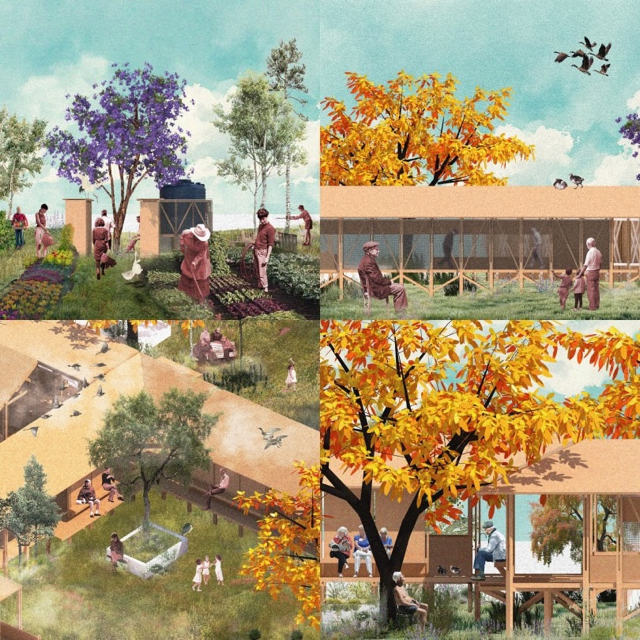
The project brief proposes a co-living space designed for five elderly individuals living on a pension. Community is the center of the design, with a shared garden and common house playing a pivotal role in fostering a sense of togetherness within the neighborhood.
The initial phase involved an in-depth study of the precinct, analyzing density, land use, and the broader context of Brisbane’s suburban landscape. Key factors such as car dependency, public transport accessibility, council regulations, plot sizes, and zoning laws informed the project’s framework.
Brisbane’s characteristic spatial sparseness shaped the project’s direction, emphasizing the creation of denser suburbs. Rather than opting for conventional governed spaces like apartments or multi-unit complexes, the design explores shared, large-plot autonomous dwellings that prioritize community connection.
The site was challenged by overland flooding during heavy rains, with water levels peaking at 1.5 meters. To address this, the design features an elevated structure, inspired by the traditional Queenslander houses found throughout Brisbane, creating a solution that responds to the local context.
Ep. II Oemah addresses the social challenges of isolation and insecurity often faced by senior communities. The design nurtures mental and physical well-being through gardening and farming, fostering interaction among residents and the surrounding community. These interactions are facilitated through a linear circulation path—“the spine”—which weaves through the space, offering a sequential spatial experience through alternating open and enclosed areas. This spine regulates light, sightlines, and movement.
Incorporating functional design elements, the project integrates water tanks into required architectural follies. These water tank follies are positioned at the spine’s entrance and endpoint, symbolizing alpha and omega, and marking the journey through the space. The spine itself becomes an “in-between space” or “Ma”, a medium for interaction and an experiential passage, filtering and shaping the way people perceive and inhabit the space—Bhanuteja