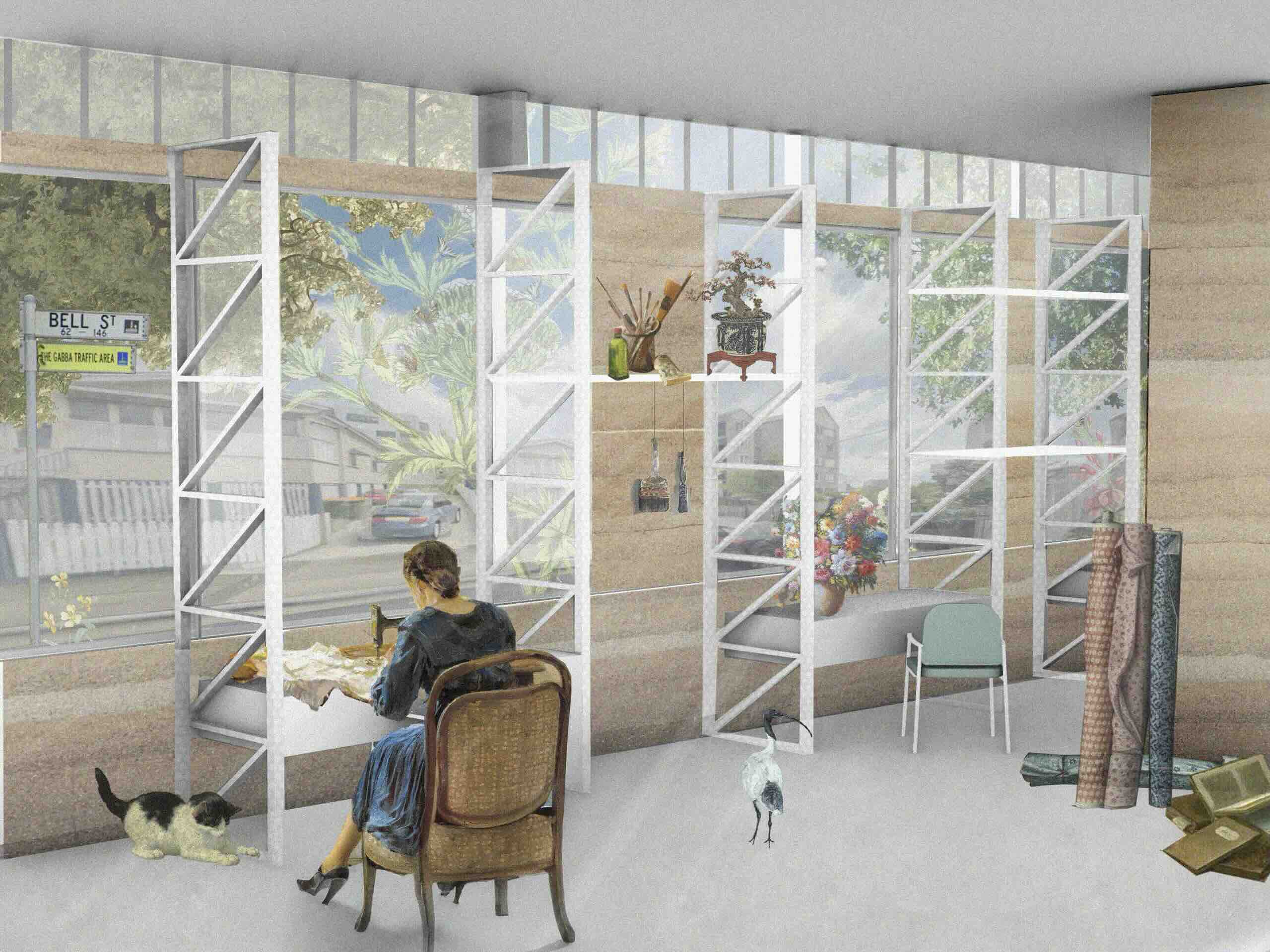
Kangaroo Point Library
It’s very easy to live an isolated life, there’s spaces for work, spaces for home, but not enough spaces in between. Because of this, interaction and social connection becomes a conscious decision, boiling down to calendar invites and catch ups over text messages. This is particularly the case in Kangaroo Point, with a demographic of young professionals. There are also many groups who are underrepresented simply because there are no spaces for them.
The project is underpinned by three key ideas which aim to tackle these problems, ensure a resilient future for kangaroo point, and set a precedent for what social housing could become in Australia.
These key ideas are:
1. An adaptive reuse of the existing buildings on site
2. A library for Kangaroo Point
3. The creation of 'third spaces'
On site, there are several existing buildings, one of these, the breeze lodge, was able to be completely retained and converted into 6-bedroom apartments, enabling share housing and filling community gaps. The remaining materials are to be demolished and reused in a hempcrete aggregate, which forms the parti walls across the project. Throughout the scheme, all adaptive reuse has been communicated in orange.
The second key idea, the Library, fills a much-needed amenity gap in Kangaroo Point. It allows for future tech integration with ambiguous spaces that offer more than the traditional library book storage. It also provides free, accessible public amenity.
Lastly, third spaces. Brisbane in general is lacking in these types of spaces where you can just exist. Throughout the project all edges can be occupied, including outside the apartments in the front porches which mediate between the corridor and the unit.
Innovation is integrated through hempcrete parti walls and a new social housing typology, which couples the apartment complex with a suburb library. Future resilience is ensured through adaptively reusing the existing building on site, and recycling materials through the hempcrete aggregate. However, resilience is not limited to sustainability. Social resilience is ensured through the creation of 'third spaces' and the integration of the public library. This promotes moments of interaction and community ownership.
It is also important to note that this project was not developed in an adaptive reuse course. This was a position I took after seeing the condition of the existing buildings on site. I think in order to become a more resilient city, ideas around reusing existing buildings, creating third spaces, and recycling materials where reuse is not possible need to become the first response to future development. My aim for this project was for it to become a template. I think it demonstrates that you do not need to sacrifice design for adaptive reuse. It also provides an example for how material recycling can be implemented in a nuanced way and demonstrates the power of community-oriented design and consideration of the pedestrian experience in shaping our cities.