Exploring the Relationship Between Compression and Explainability in Deep Learning
The demand for AI compute is growing rapidly, driving up costs, energy use, and infrastructure requirements. At the same time, many of the applications where AI is most useful are tightly resource or latency constrained. Compression techniques help reduce the resource footprint of AI systems, but their effect on a model’s decision-making remains poorly understood.
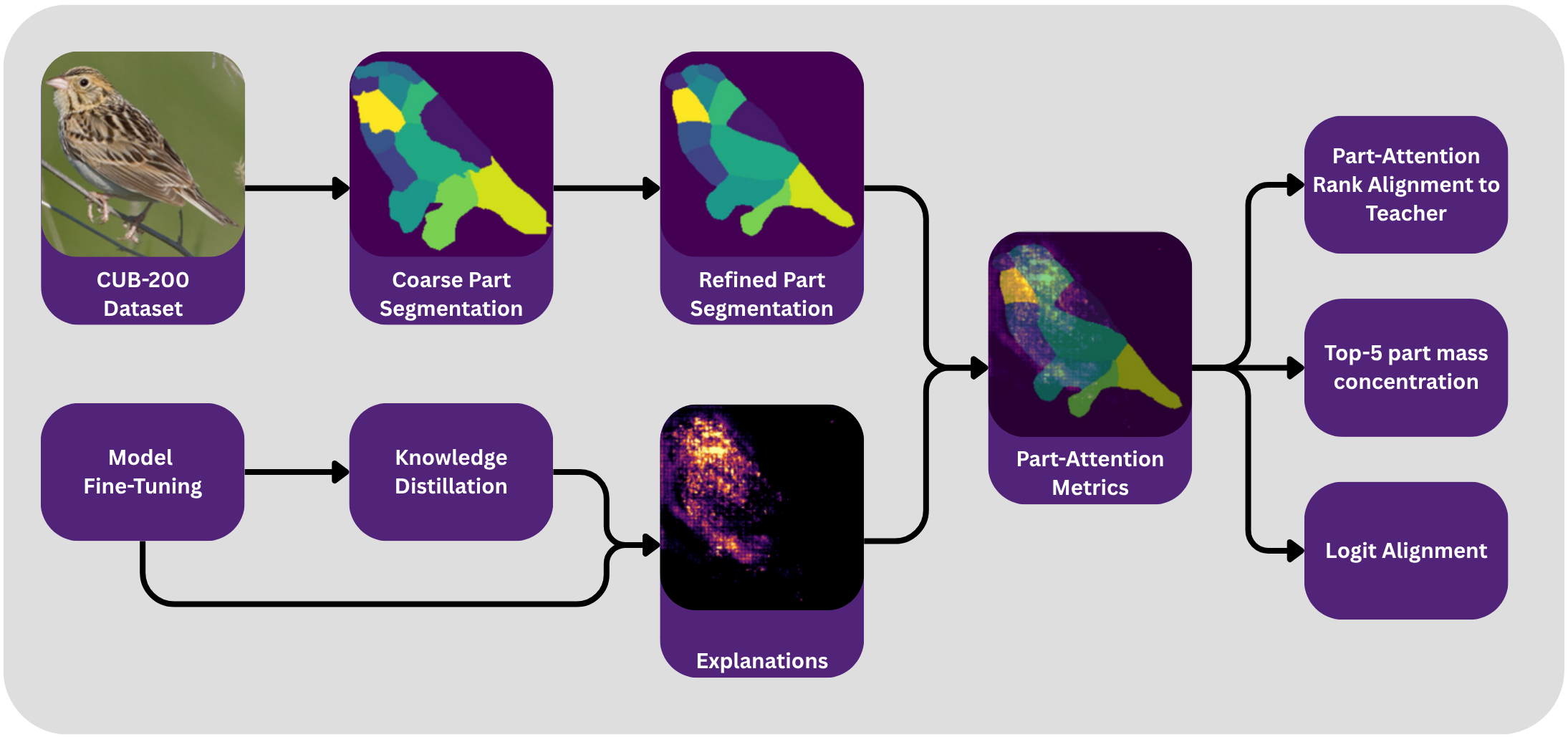
This project investigates how compression via knowledge distillation changes what features image models focus on when making a prediction. It introduces a novel quantitative framework that, unlike prior work, links model explanations to a semantically meaningful ground truth before comparison. By segmenting images into semantically meaningful parts, this framework measures and compares how a model's attention is distributed across these features, allowing for an objective assessment of how a student model's reasoning diverges from its larger teacher.
The results indicate that as compression increases, student models rely on increasingly different features than the teacher. While knowledge distillation consistently helps to realign the student’s decision-making process and improve model accuracy, the extent of this recovery is ultimately limited by the capacity gap between the models.
Themes
 Smart Tech Award