A Receding Horizon Reinforcement Learning Framework for UQ Campus Chiller Energy Management
The increasing complexity of energy networks due to renewable energy integration presents significant challenges for building energy management systems. Commercial buildings account for approximately 24% of Australia's electricity consumption, with HVAC systems responsible for up to 70% of base energy usage and chillers consuming 25-35% of total energy. While model predictive control (MPC) approaches dominate building energy management research, their reliance on accurate system models and complex optimization problems limit effectiveness. Existing reinforcement learning (RL) implementations often assume chiller homogeneity, utilize discretized action spaces, and neglect exogenous factors affecting building cooling demand predictions, constraining energy savings to approximately 10-12%.
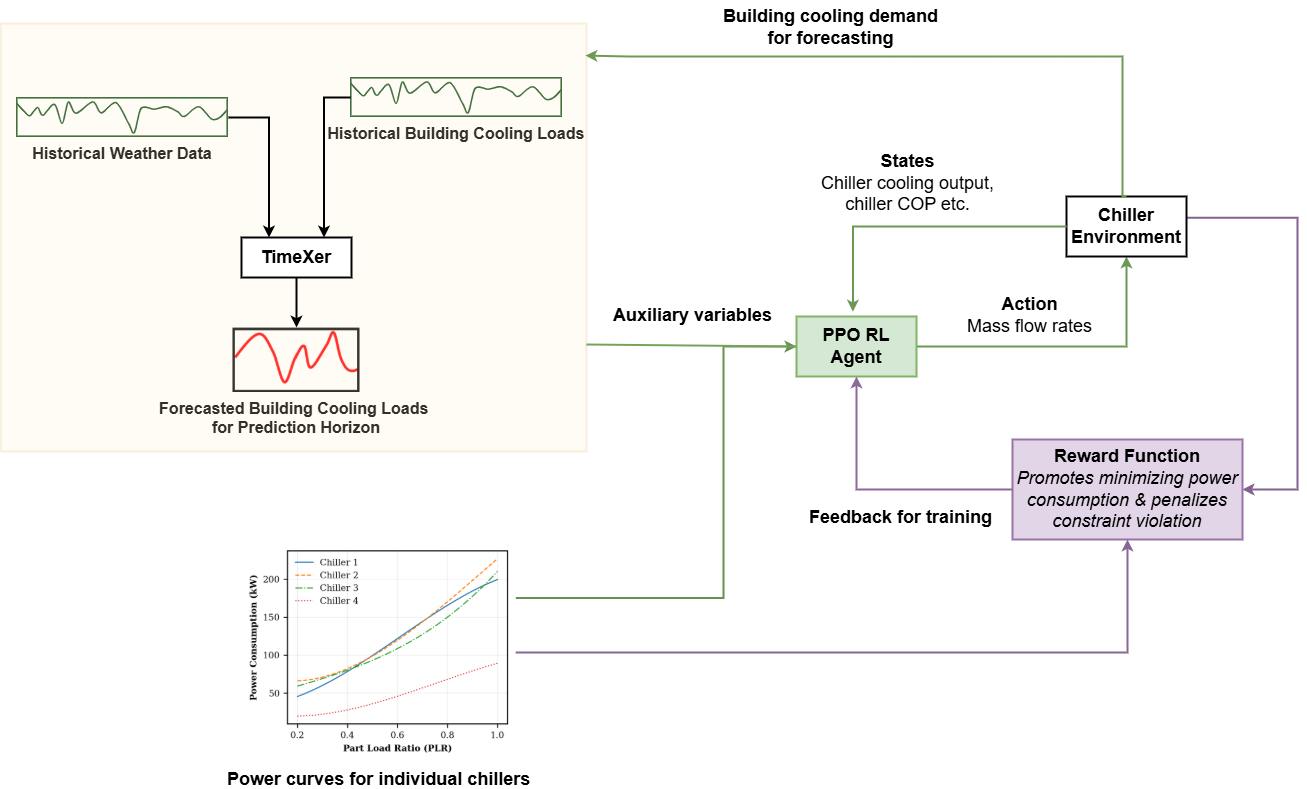
This thesis presents a deep reinforcement learning optimization framework for multi-chiller energy management applied to the University of Queensland's Advanced Engineering Building chiller bank. The approach employs a Proximal Policy Optimization (PPO) agent operating within a receding-horizon structure to regulate chilled water mass flow rates across four chillers while maintaining consistent supply temperatures. Key innovations include a heterogeneity-aware reward formulation capturing individual chiller efficiency characteristics and a TimeXer transformer-based forecasting model incorporating historical demand patterns and weather variables for improved prediction reliability.
Experimental validation over two months demonstrates power reductions of up to 28% compared to existing rule-based control and 8% improvement over conventional single-step RL implementations. These savings resulted from improved demand-supply matching accuracy and enhanced chiller coefficient of performance. The research contributes a scalable methodology bridging traditional model-based optimization with contemporary reinforcement learning techniques, offering significant potential for similar building energy systems.